The BBC ran a show last Thursday on a new hypothesis concerning early migrations to the Americas. It was more or less universally believed that humans first reached the Americans over the land bridge from Asia during the last ice age.
“This version was so accepted that few archaeologists even bothered to look for artefacts from periods before 10,000BC. But when Jim Adavasio continued to dig below the Clovis layer at his dig near Pittsburgh, Pennsylvania, he found blades and blade cores dating back to 16,000BC. His findings were dismissed as erroneous; too astonishing to be credible. The Clovis consensus had too many reputations behind it to evaporate easily. Some archaeologists who backed Adavasio's conclusions with other similar data were accused of making radiocarbon dating errors or even of planting finds.”
What’s even more surprising is from where these immigrants may have come.
"[Douglas Wallace] spotted the similarity in production method between the Clovis point and tools made by the Solutrean neolithic (Stone Age) culture in southwest France. At this stage his idea was pure hypothesis, but could the first Americans have been European? The Solutreans were a remarkably society, the most innovative and adaptive of the time. They were among the first to discover the value of heat treating flints to increase strength. Bradley was keen to discover if Solutrean flintknapping styles matched Clovis techniques. A trawl through the unattractive flint offcuts in the storerooms of a French museum convinced him of the similarities, even though five thousand kilometres lay between their territories."
Although the evidence from stone-working techniques is not so impressive, modern genetic techniques provide strong support for this theory.
“In the DNA profile of the Ichigua Native American tribe he identified a lineage that was clearly European in origin, too old to be due to genetic mixing since Columbus' discovery of the New World. Instead it dated to Solutrean times. Wallace's genetic timelines show the Ice Age prompted a number of migrations from Europe to America. It looks highly likely that the Solutreans were one.”
The implications of this new theory are obvious:
“The impact of this new prehistory on Native Americans could be grave. They usually consider themselves to be Asian in origin; and to have been subjugated by Europeans after 1492. If they too were partly Europeans, the dividing lines would be instantly blurred. Dr Joallyn Archambault of the American Indian Programme of the Smithsonian Institute offers a positive interpretation, however. Venturing across huge bodies of water, she says, is a clear demonstration of the courage and creativity of the Native Americans' ancestors. Bruce Bradley agrees. He feels his Solutrean Ice Age theory takes into consideration the abilities of people to embrace new places, adding, ‘To ignore this possibility ignores the humanity of people 20,000 years ago.’” Labels: 2007, History, Politics
Ansgarr's Technology Problems
Jesus through the Centuries
Following are some passages from Pelikan's Jesus through the Centuries:
“As even her most fervent enthusiasts acknowledge, Christian language about the Blessed Virgin Mary in the Orthodox and Catholic traditions has let itself get into great difficulties whenever it has made her an object of devotion in her own right rather than, in Dante’s phrase, as “the face that most resembles Christ’s,” who was her Son and her Lord and Redeemer. And in the Protestant traditions, on the other hand, the violent act of separating loyalty to Jesus Christ from the celebration of Mary of which it has so long been an essential partner has led not to the glorification of Him alone, as was intended, but to Christological chaos instead of Christological confession.” – Preface to the History Book Club Edition
“Everyone must acknowledge, therefore, that Christian tradition had precedence, chronologically and even logically, over Christian Scripture; for there was a tradition of the church before there was ever a New Testament, or any individual book of the New Testament. By the time the materials of the oral tradition found their way into written form, they had passed through the life and experience of the church, which laid claim to the presence of the Holy Spirit of God, the selfsame Spirit that the disciples had seen descending upon Jesus at his baptism and upon the earliest believers on the fiftieth day after Easter, in the miracle of Pentecost. It was to the action of that Spirit that Christians attributed the composition of the books of the “new testament,” as they began to call it, and before that of the “old testament,” as they referred to the Hebrew Bible. Because the narrative of the sayings of Jesus and of the events of his life and ministry had come down to the evangelists and compilers in this context, anyone who seeks to interpret one or another saying or story from the narrative must always ask not only about its place in the life and teachings of Jesus, but also its function within the remembering community.” Jesus through the Centuries, p. 10 “Very often, of course, this description of the opposition between Peter and Paul, and between law and gospel, was cast in the language of the opposition between Roman Catholicism (which traced its succession to Peter as the first pope) and Protestantism (which arose from Luther’s interpretation of the epistles of Paul). Luther’s favorite among those epistles, the letter to the Romans, became the charter for this supposed declaration of independence from Judaism. Since then, however, scholars have not only put the picture of Jesus back into the setting of first-century Judaism; they have also rediscovered the Jewishness of the New Testament, and particularly of the apostle Paul, and specifically of his Epistle to the Romans. They have concluded, in the words of Krister Stendahl, that “in this letter Paul’s focus really is the relation between the Jews and the Gentiles, not the notion of justification or predestination and certainly not other proper yet abstract theological topics.” For such a reading of the epistle, moreover, “the climax of Romans is actually chapters 9-11, i.e., his reflections on the relation between the church and synagogue, the church and the Jewish people – not ‘Christianity’ and ‘Judaism,’ not the attitudes of the gospel versus the attitudes of the law.” Jesus through the Centuries, p. 18 “For that assertion of Tertullian represents nothing less than a new understanding of the meaning of history, and understanding according to which Jesus was not simply going to be the end of history by his second coming in the future, as a naïve and literalistic apocalypticism had viewed him, but already was the Turning Point of History, a history that, even if it were to continue, had been transformed and overturned by his first coming in the past. …During those centuries, however, it was…also the cultural significance of Jesus as hinge on which history turned and therefore as the basis both for a new interpretation of the historical process and for a new historiography.” Jesus through the Centuries, pp. 25-26 “Thus the entire history of Israel had reached its turning point in Jesus as prophet, as priest, and as king. After the same manner, he was identified as the turning point in the entire history of all the nations of the world, as that history was encapsulated in the history of the “mistress of nations,” the Roman empire. Although this was in fact a leitmotiv of the third, fourth, and fifth centuries, the most massive and most influential monument of that identification was what the author himself called in his preface his “great and arduous taks,” Augustine’s City of God. For this task of locating Jesus within world history, as indeed for the entire enterprise of interpreting the person and the message of Jesus to the Gentile world, the New Testament, as a book written chiefly by Jewish Christians, offered far less explicit guidance than it did for the specification of his locus within the history of Israel. But it did speak of his having come only in the fullness of time.” Jesus through the Centuries, p. 28 “And the clinching argument against the theory of cycles in history was the life and person of Jesus Christ: Because “Christ died for our sins once and for all, and, rising from the dead, dies no more,” it also had to be true that Plato had taught in the Academy at only one point in history, not over and over again “during the countless cycles that are yet to be.” It was the consideration of the life, death, and resurrection of Christ, as an event that was single and unrepeatable and yet at the same time as a message and “mystery announced from the very beginning of the human race,” that made it possible for Christopher Dawson to call Augustine, with only slight exaggeration, “not only the founder of the Christian philosophy of history,” but “actually the first man in the world to discover the meaning of time.” Jesus through the Centuries, pp. 29-30 “The modern skeptical world has been taught for some 200 years a conception of the human nature in which the reality of evil, so well known to the ages of faith, has been discounted. Almost all of us grew up in an environment of such easy optimism that we can scarcely know what is meant, though our ancestors knew it well, by the satanic will. We shall have to recover this forgotten but essential truth – along with so many others that we lost when, thinking we were enlightened and advanced, we were merely shallow and blind.” Walter Lippman, 30 October 1941. Jesus through the Centuries, p. 76. “The clinching argument in favor of the holiness of marriage came for Augustine from some other words of the apostle Paul: “Husbands, love your wives, as Christ loved the church and gave himself up for it…This is a great sacrament [magnum sacramentum], and I take it to mean Christ and the church.” Marriage was a sacrament of Christ and the church.” Jesus through the Centuries, p. 78 “Jesus was the only unqualified exception that Augustine would grant to the rule of the universality of original sin. There was, however, one other exception that he had to consider: Mary the Virgin Mother of Jesus. After rejecting the contention that various other saints, both male and female, had been totally sinless, Augustine continued: “We must except the Holy Virgin Mary, concerning whom I wish to raise no question when it touches the subject of sins, out of honor to the Lord; for from him we know what abundance of grace for overcoming sin in every particular was conferred upon her who had the merit to conceive and to bear him who undoubtedly had no sin.” Jesus through the Centuries, pp. 80-81 “whenever devotion or speculation glorified Christ as Lord and King in such a way as to lose touch with the Man of Nazareth, Mary would become a substitute for him – human, compassionate, accessible. And then the devotion to her and the speculation about her were no longer being carried on “out of honor to the Lord.” Jesus through the Centuries, p. 81 “Because the one who by excellency of nature transcends all quantity and size and magnitude, who has his being in the form of God, has now, by taking upon himself the form of a slave, contacted himself into a quantity and size and has acquired a physical identity, do not hesitate any longer to draw pictures and to set forth, for all to see, him who has chosen to let himself be seen: his ineffable descent from heaven to earth; his birth from the Virgin; his baptism in the Jordan; his transfiguration on Mount Tabor; the sufferings that have achieved for us freedom from suffering; the miracles that symbolized his divine nature and activity when they were performed through the activity of his [human] flesh; the burial, resurrection, and ascension into heaven by which the Savior has accomplished our salvation – describe all these events, both in words and in colors, both in books and in pictures.” John of Damascus, On the Images, Jesus through the Centuries, p. 92 “Thus the God who had prohibited religious art as the idolatrous effort to depict the divine in visible form had now taken the initiative of depicting himself in visible form, and had done so not in metaphor or in memorial but in person and, quite literally, “in the flesh.” The metaphysical had become historical, and the cosmic Logos who was the true image of the Father from eternity had now become a part of time and could be portrayed in an image of his divine-human person as this had carried out the events of salvation history. The creation of Adam and Eve in the image of God had been an anticipation of the coming of Jesus the Second Adam and of Mary the Second Eve, so that the description of Christ and of his Mother could be at the same time the description of Christ and of his Mother could be at the same time the description of the true image of God in humanity. The image portrayed him in the individual specificity of his unique person, not as humanity in the abstract. Nevertheless, the humanity of his saints and of all who had been made alive in him, was a humanity suffused with the presence of divinity: it was, in this sense, the “deified” body of Christ that was being portrayed, and the most characteristic Eastern Orthodox way of speaking about the salvation granted in Christ has been to call it “deification” (theōsis in Greek, obozhenie in Russian). The iconography of the icon (to resort deliberately to an almost unavoidable tautology) was well designed to carry out both of these themes simultaneously: specificity and deification, and therefore what one of the most profound twentieth-century interpreters of icons, Evgenii Nikolaevich Trubetskoi, has called “theory of colors” or “contemplation in images.” Jesus through the Centuries, pp. 92-93 “The use of the sign of the cross, as a mark of identification and a means of warding off the power of demons, is not mentioned as such in the New Testament; but it appears very early in Christian history, and when it is mentioned it is already being taken for granted. Tertullian declares that “at every forward step and movement, at every going in and out… in all the ordinary actions of daily life, we mark upon our foreheads the sing,” and the sign of the cross became the prime evidence for the existence of an unwritten tradition that everyone observed even though it was not commanded in the Bible. Those who did not belong to the church could not help noticing the practice. The emperor Julian, whom Christians called “the Apostate” because he had forsaken the Christianity of his childhood, complained to the Christians in the fourth century: “You adore the wood of the cross and draw its likeness on your foreheads and engrave it on your housefronts…” Jesus through the Centuries, p. 96 “The Cross was believed to possess all of this victorious power because it had been the instrument for the greatest victory of them all, the cosmic victory of the power of God over the power of the devil in the death and resurrection of Jesus. “The word of the cross is called the power of God,” John of Damascus said, “because the might of God, that is, his victory over death, has been revealed to us through it.” The earliest versions of the idea had described this victory as a trick that God had played on the devil, death, and sin, the alliance of enemies who had held humanity in thrall. In one of the most striking – and one of the most problematical – of images for the trick, the devil whit his allies was depicted as a giant fish that had devoured every human being since Adam. When the humanity of Christ was cast into the pool, the fish took it to be yet another victim to be swallowed up. But hidden within this bait of the human nature of Christ was the hook of his divine nature, so that when the devil gobbled up the man Jesus in his death on the cross, he was impaled on the divinity. He had to regurgitate the humanity of Jesus, and with it all those whom Jesus had taken as his own; and death and the devil, who had taken the human race, were now themselves taken. Through the cross, therefore, liberation and victory had come. In a more subtle and sophisticated form, this theory of the cross became the metaphor of Christus Victor, which Gustaf Aulén made the title of a controversial book on the meaning of the cross. Here, in what Aulén does not hesitate to call the “classic” theory of how the cross saves, the cross became the sign of God’s invasion of enemy territory and of the “wondrous battle [mirabile duellum]” by which Jesus Christ had accomplished the salvation of the human race. Shedding the cruder aspects of the earlier metaphor of deception, the theme of Christus Victor nevertheless retained the interpretation that the enemies of God and man were the ones with whom Christ on the cross had to contend. The death of Christ on the cross was therefore his capitulation to those enemies and to their power, before which he made himself weak. But he took those enemies into the grave with him. In the resurrection Christ was set free from their power, but they remained behind in the grave. Although this interpretation of the cross as the power of God was more prominent in the Greek East than in the Latin West, it was never lost even in the West; and, according to Aulén, the Reformation revived it… As the act of divine power manifest in Christus Victor, the cross was interpreted as the enactment, in the arena of the cosmos and of world history, of the dramatic battle between God and the enemies of God over the future of humanity. Whatever its theological advantages or disadvantages may have been, this theory of the atonement had the advantage, in relation to the art and music of the Middle Ages, of being able to connect the cross with the resurrection as two parts of a single action. In the liturgical music of the Middle Ages, that connection took the form of setting Good Friday and Easter into the greatest possible contrast: Good Friday was the only day in the church year when the sacrifice of the Mass was not celebrated, because on that day it was the original sacrifice of the cross on Calvary that was to be commemorated. Following a tradition that went back at least to Origen in the first half of the third century, medieval art depicted the crucifixion as having taken place on the very place where the skull of Adam was buried; and the processions and the liturgical drama of the Middle Ages kept the motif of Christus Victor alive even when Latin theology was no longer able to deal with it adequately because of its preoccupation with interpreting the death of Christ as an act of satisfaction.” Jesus through the Centuries, pp. 99-101 “Abelard’s critics found such language [i.e. “to reveal the love [of God] to us or to convince us how much we ought to love him ‘who did not spare even his own Son for us] about the wisdom of the cross not so much incorrect as inadequate. Of course Christ crucified was an example of patience, everyone would agree; and no one would deny that the cross of Christ was the supreme revelation of the love of God, and indeed the very definition of love, whether divine or human. The question was whether this language exhausted the wisdom of the cross or whether a more profound consideration of the cross would lead to some other way of thinking and speaking about it. That other way found its definitive formulation in one of the most influential works of medieval thought, Why God Became Man (Cur dues homo) by Anselm of Canterbury. More than any other treatise between Augustine and the Reformation on any other doctrine of the Christian faith, Anselm’s essay has shaped the outlook not only of Roman Catholics, but of most Protestants, many of whom have paid him the ultimate compliment of not even recognizing that their version of the wisdom of the cross comes from him, but attributing it to the Bible itself.” Jesus through the Centuries, pp. 106-107 “Throughout his life Francis identified himself with the events of the suffering of Christ – so much so that it would probably be possible to reconstruct almost the entire Gospel history of the Passion from the individual scenes in which Francis has been depicted as a participant. “Christ hung upon his Cross, poor and naked and in great pain,” Bonaventure writes, “and Francis wanted to be like him in everything.” Jesus through the Centuries, pp. 139-140 “In the words of Beatrice to Dante that follow, Mary is “the rose in which the divine Word was made flesh,” but like all other flowers in the divine “garden,” she, too, “blossoms under the rays of Christ,” not finally of her own powers.” Jesus through the Centuries, p. 150 Labels: 2007, History, Quotations
Jaroslav Pelikan's "Interpreting the Bible and the Constitution"
 I read Jaroslav Pelikan's Interpreting the Bible and the Constitution last week and thought I would type up several of the passages I held to be of interest. The book itself was the first-rate scholarship I have grown to expect of the author and I would recommend it to anyone with an interest in one or the other of the 'Great Codes' discussed. The comparison between the interpretation and American religious and civil texts is a fruitful one, and the history of each can serve to illuminate the other.
“To those questioners who identify themselves with the mainstream of the Christian tradition, I have often responded with one of my favorite quotations from Cardinal John Henry Newman’s Apologia pro vita sua (which may, for that matter, be more true of me than it was of him): ‘I have changed in many things: in this I have not. From the age of fifteen, dogma has been the fundamental principle of my religion: I know no other religion.’ But when others, who stand outside that tradition or who identify themselves as ‘secular humanists,’ have pressed me about the nature of ‘dogma’ as the normative teaching of the church in relation to the doctrinal authority of the Bible, I have found that the most helpful analogy for it is the authority of the United States Constitution in American society and its complex relation to the standing of the Supreme Court of the United States as its official and decisive interpreter.” “Great Code[:] There is a familiar and venerable text, centuries old by now, which is the product of multiple authorship (although even after generations of historical research and literary analysis we are not always in a position to determine with absolute precision just who wrote, or rewrote, which parts of it). The text was originally composed under very specific circumstances, which modern historical scholarship has done much to illumine. But far transcending the history of its original composition is its official standing ever since, for it has been adopted by a community as its normative Great Code, and therefore as occupying a position that in some profound sense stands beyond its own history: ‘not spake but speaketh!’ That normative status is based on the assumption that it can be applied to any and all of the radically changed situations of later times, many of which the writers who originally framed it could not themselves conceivably have foreseen. Every official action of the community thus had the obligation of conforming to it, or any rate of not violating it, and of demonstrating that conformity when challenged to do so; and members of the community are under the strictest possible obligation to obey it. Therefore its words and phrases have for centuries called forth meticulous and sophisticated – and sometimes painfully convoluted – interpretation, as well as continual reinterpretation. By now, this interpretation has grown into a massive corpus of authoritative, if often controversial, commentary. Yet the text does not itself prescribe the method of such interpretation; nor does it specifically identify the authoritative agency that bears the ultimate responsibility for determining the binding interpretation, much less for revising it” “With the reduction in the private authority of Christian Scripture, and especially in its public authority, American Scripture has been called upon to fill some of the gap. At least for some Americans, therefore, the Ten Amendments of the Bill of Rights now seem to provide a version of the function that used to be preformed for their grandparents by the Ten Commandments of the Decalogue – with the arts often being called upon to provide them with a substitute for the mystical experience of divine transcendence.’ “[The Nicene Creed] affirms that the resurrection of Christ took place ‘in accordance with the Scriptures.’ This New Testament formula (I Cor 15.4) refers most directly to various passages of the Old Testament – which is what the term ‘Scripture [graphe]’ means in the New Testament – that are said to have prophesied the death and resurrection and that are said now to have been fulfilled; in fact, in some passages of the Gospels (for example, Mt 26:54-56) it almost sounds as though the very purpose of an event in the life of Jesus had been to fulfill a passage of the Old Testament Scripture. But ‘according to [kata] the Scriptures’ has, of course, an unavoidably normative connotation as well, which is why ‘in accordance with’ is often preferable to ‘according to’ as a translation of the Greek preposition.” “Yet the contrary Catholic and Orthodox doctrine of authority, as restated in the nineteenth century, that not Scripture alone but ‘genuine tradition, i.e., the unbroken transmission, partly oral, partly in writing, of the doctrine delivered by Jesus Christ and the apostles, is an authoritative source of teaching for all successive generations of Christians’ could make theological learning even more important; for ‘this tradition is partly to be found in the consensus of the great ecclesiastical bodies, standing in historical continuity with the primitive church, partly is to be gathered by a scientific [wissenschaftlich] method from the written documents of all centuries.’” “At the same time, an Eastern Orthodox confession of the seventeenth century, written in Greek, could quote the Greek verb ereunate [search] from this verse, in opposition to the universally Protestant doctrine of the ‘perspicuity of Scripture,’ to prove the exact opposite, namely, that ‘if Divine Scripture were clear to all Christians who read it, the Lord would not have commanded those who desire to obtain salvation to search it.’” “To account for the puzzling, or even (to him, at any rate) troubling, discovery ‘that there was no formal acknowledgement on the part of the Church of the doctrine of the Holy Trinity till the fourth [century],’ namely, at the First Council of Nicaea in 325, John Henry Newman formulated the axiom: ‘No doctrine is defined till it is violated.’”
“Yet in the event, that affirmation of sola Scriptura in principle was accompanied, in Luther and even in Zwingli and even in the Anabaptists, by the retention in practice of a substantial piece of the creedal and dogmatic tradition. But later Protestants in the eighteenth and nineteenth centuries, claiming to be carrying out for various doctrines a radical intention that the Reformers of the sixteenth century had been able to accomplish, sought to be more consistent than they had been in pressing for the original intent of the New Testament over against the later creeds and liturgies.”
“According to John Henry Newman, when the Virgin Mary was named Theotokos by the Council of Ephesus in 431, this was ‘an addition, greater perhaps than any before or since, to the letter of the primitive faith’ – although that council itself made a special point of explaining that this was not an addition [prosthēkē] but an amplification [plērophoria].”
“in response to the Protestant insistence on sola Scriptura, the Council of Trent codified the correlation in this way: ‘Following the example of the orthodox fathers, the council accepts and venerates with a like feeling of piety and reverence [pari pietatis affectu] all the books of both the Old and New Testament, since the one God is the author of both, as well as the traditions concerning both faith and conduct, as either directly spoken by Christ or dictated by the Holy Spirit, which have been preserved in unbroken sequence in the Catholic Chruch.’ It is instructive to trace this correlation through the legislation of the early ecumenical councils of the church.
Adopting a formula of the New Testament (1 Cor 15.3-4) about the Old Testament, the Second Ecumenical Council, which was the First Council of Constantinople in 381, expanded the creed originally set down by the First Ecumenical Council, the Council of Nicaea in 325, to confess that Christ ‘rose up on the third day in accordance with the Scriptures.’ The Third Ecumenical Council, the Council of Ephesus in 431, adopted its statement of faith ‘not by way of addition but in the manner of a full statement, even as we have received and posses it from of old from the Holy Scriptures and from the tradition of the holy fathers.’ The Fourth Ecumenical Council, the Council of Chalcedon in 451, concluded its definition of faith about the one person and the two natures of Jesus Christ with and appeal to a multiple authority: ‘just as the [Old Testament] prophets taught from the beginning about him, and as [in the Gospels of the New Testaement] the Lord Jesus Christ himself instructed us, and as the creed of the fathers [the tradition of the Councils of Nicaea and Constantinople] handed it down to us.’ The Fifth Ecumenical Council, the Second Council of Constantinople in 553, similarly concluded with an appeal jointly to Scripture and to tradition, including the tradition of its predecessor councils: ‘Such then are the assertions we confess. We have received them from Holy Scripture, from the teaching of the holy fathers, and from the definitions about one and the same faith made by the aforesaid holy councils.’ The Sixth Ecumneical Council, the Third Council of Constantinople in 680-81, declared that it was ‘following without deviation in a straight path after the holy and accepted fathers [and that it] piously accorded in all things with the five holy and universal councils,’ to which ‘this holy and universal council of ours has also, in its turn, under God’s inspiration [theopneustōs], set its seal,’ therefore employing for itself (and for the other orthodox councils and traditions) the technical New Testament term for divine inspiration (2 Tm 3.16) that had originally been applied to the Old Testament Scriptures. And the Seventh Ecumenical Council, the Second Council of Nicaea in 787, declared its purpose to be ‘that the divinely inspired tradition of the catholic church should receive confirmation by a public decree,’ anathematizing ‘anyone [who] rejects any written or unwritten tradition of the church.’” Labels: 2007, Christianity, History, Quotations
Praise of Folly
I recently finished reading Erasmus’ Praise of Folly on my daily commute to Edinburgh Park. A masterpiece of satire, Praise of Folly was written for Erasmus’ friend, St. Thomas More. I wanted to post a few passages that caught my eye: “Closely related to them are the people who’ve adopted the foolish but pleasurable belief that if they see some carving or painting of that towering Polyphemus, Christopher, they’re sure not to die that day, or if anyone addresses a statue of Barbara in the set formula he’ll return unhurt from battle, or a man will soon become rich if he approaches Erasmus on the proper days with the proper bits of candle and the proper scrapes of prayer. They’ve already got a second Hippolytus, but in George they’ve found another Hercules, too. They piously deck out his horse with trappings and amulets and practically worship it. Its favours are sought with some new small offering, and an oath sworn by the saint’s bronze helmet is fit for a king. And what am I to say about those who enjoy deluding themselves with imaginary pardons for their sins? They measure the length of their time in Purgatory as if by water-clock, counting centuries, years, months, days and hours as though there were a mathematical table to calculate them accurately. Then there are people who rely on certain magic signs and prayers thought up by some pious imposter for his own amusement or for gain – they promise themselves everything, wealth, honours, pleasure, plenty, continual good health, long life, a vigorous old age, and finally a seat next to Christ in heaven. However, that’s a blessing they don’t want until the last possible minute, that is, when the pleasures of this life have left their tenacious and reluctant grasp to make way for the heavenly joys to come.” - Erasmus, Praise of Folly.
“I must press on, and yet I can’t pass over without a mention those who are no better than the humblest worker but take extraordinary pride in an empty title of nobility, one tracing his family back to Aeneas, another to Brutus, a third to Arcturus. They display the statues and portraits of their ancestors everywhere, tot up their great-grand-fathers and great-great-grandfathers, know all the old family names by heart, though they’re not far off being dumb statues themselves and could well be worse than the statuary they display. And yet, there are always plenty of fools like themselves to look up to this sort of brute as if he were a god.” - Erasmus, Praise of Folly.
“Now, just as Nature has implanted his personal self-love in each individual person, I can see she has put a sort of variety in every nation and city. Consequently the British think they have a monopoly, amongst other things, of good looks, musical talent and fine food. The Scots pride themselves on their nobility and the distinction of their royal connexions as much as on their subtlety in dialectic. The French lay claim to polite manners, the Parisians demand special recognition for their theological acumen which they think exceeds nearly everyone else’s. The Italians usurp culture and eloquence, and hence they’re all happy congratulating themselves on being the only civilized race of men. In this kind of happiness the Romans take first place, still blissfully dreaming of the past glories of Rome, while the Venetians have their own opinion of their noble descent to keep them happy. Meanwhile the Greeks, as originators of the arts, imagine they should still share the honours of the illustrious heroes of their past; while the Turks and all the real barbarian riff-raff actually demand recognition for their religion and pour scorn on Christians for their superstition. The Jews go even further, still faithfully awaiting their Messiah and clinging fast to their Moses to this very day. The Spaniards admit no rival in the glories of war, while the Germans boast of their height and their knowledge of the magic arts.” - Erasmus, Praise of Folly.
“Finally, man's mind is so formed that it is far more susceptible to falsehood than to truth. If anyone wants an immediate clear example of this he has only to go to church at sermon time, where everyone is asleep or yawning or feeling queasy whenever some serious argument is expounded, but if the preacher starts to rant (I beg your pardon, I mean orate) on some old wives' tale as they often do, his audience sits up and takes notice, open-mouthed. And again, if there's some legendary saint somewhat celebrated in fable (you can put George or Christopher or Barbara in that category if you need an example) you'll see that he receives far more devout attention than Peter or Paul or even Christ himself. But this is not the for the moment.” - Erasmus, Praise of Folly.
“Think of the many who set up a candle to the Virgin, Mother of God, and at midday too, when it isn't needed, and of the few who care about emulating her chastity of life, her modesty and love of heavenly things. Yet that is surely the true way to worship and by far the most acceptable to heaven.” - Erasmus, Praise of Folly.
“And in my opinion Christians would show sense if they dispatched these argumentative Scotists and pigheaded Ockhamists and undefeated Albertists along with the whole regiment of sophists to fight the Turks and Saracens instead of sending those armies of dull-witted soldiers with whom they've long been carrying on war with no result. Then, I think, they'd witness a really keen battle and a victory such as never before. For who is too cold-blooded to be fired by their ingenuities, too stupid to be stung into action by their attacks? And is there anyone so keen-sighted that they can't leave him groping in the dark? You may suppose that I'm saying all this by way of a joke, and that's not surprising seeing that amongst the theologians themselves there are some with superior education who are sickened by these theological minutiae which they look upon as frivolous. Others too think it a damnable form of sacrilege and the worst sort of impiety for anyone to speak of matters so holy, which call for reverence rather than explanation, with a profane tongue, or to argue with the pagan subtlety of the heathen, presume to offer definitions, and pollute the majesty of divine theology with words and sentiments which are so trivial and even vile. Yet all the while they are so happy in their self-satisfaction and self-congratulation, and so busy night and day with these enjoyable tomfooleries, that they haven't even a spare moment in which to take a single look at the gospel or the letters of Paul. And while they're wasting their time in the schools with this nonsense, they believe that just as in the poets Atlas holds up the sky on his shoulders, they support the entire Church on the props of their syllogisi and without them it would collapse. Then you can in their happiness when they fashion and refashion the holy scriptures at will, as if these were made of wax, and when they insist that their conclusions, to which a mere handful of scholastics have subscribed, should carry more weight than the laws of Solon and be preferred to papal decrees. They also set up as the world's censors, and demand recantation of anything which doesn't exactly square with their conclusions, explicit and implicit, and make their oracular pronouncements: "This proposition is scandalous; this is irreverent; this smells of heresy; this doesn't ring true." As a result, neither baptism nor the gospel, neither Paul, Peter, St Jerome, Augustine nor even Thomas, the 'greatest of the Aristotelians', can make a man Christian unless these learned bachelors have given their approval, such is the refinement of their judgment. For who could have imagined, if the savants hadn't told him, that anyone who said that the two phrases "chamber-pot you stink" and "the chamber-pot stinks", or "to boil in a pot" and "to boil a pot" mean much the same thing can't possibly be a Christian? 106 Who could have freed the Church from the dark error of its ways when no one would ever have read about these if they hadn't been published under the great seals of the school? And aren't they perfectly happy doing all this?” - Erasmus, Praise of Folly.
“To sum up (or I shall be pursuing the infinite), it is clear that the Christian religion has a kind of kinship with folly in some form, though it has none at all with wisdom. If you want proofs of this, first consider the fact that the very young and the very old, women and simpletons, are the people who take the greatest delight in sacred and holy things, and are therefore always found nearest the altars, led there doubtless solely by their natural instinct. Secondly, you can see how the first great founders of the faith were great lovers of simplicity and bitter enemies of learning. Finally, the biggest fools of all appear to be those who have once been wholly possessed by zeal for Christian piety. They squander their possessions, ignore insults, submit to being cheated, make no distinction between friends and enemies, shun pleasure, sustain themselves on fasting, vigils, tears, toil and humiliations, scorn life and desire only death - in short, they seem to be dead to any normal feelings, as if their spirit dwelt elsewhere than in their body. What else can that be but madness? And so we should not he surprised if the apostles were thought to be drunk on new wine, and Festus judged Paul to be mad. But now that I have donned 'the lionskin', let me tell you another thing. The happiness which Christians seek with so many labours is nothing other than a certain kind madness and folly. Don't be put off by the words, but consider the reality. In the first place, Christians come near to agreeing with the Platonists that the soul is and bound down by the fetters of the body which by gross matter prevents the soul from being able to contemplate and enjoy things as they truly are. Next, Plato used philosophy as a preparation for death because it leads mind from visible and bodily things, just as death does. And so as long as the mind makes proper use of the organs the body has it is called sane and healthy, but once it begins to break its bonds and tries to win freedom, as if it were planning an escape from prison, men call it insane. If this happens through disease or some organic defect, by general consent it is called insanity. Even so, we see this type of person foretelling the future, showing a knowledge of languages and literature they had never previously known and giving clear indication of something divine. Undoubtedly this happens because the mind is beginning to free itself from contamination by the body and exercise its true natural power. I think this also explains why those who are struggling at the hour of death often expel something similar, so that they speak wonders as if inspired. Again, if this happens through pious fervour, it might not be quite the same kind of insanity, but is so much like it that most people make no distinction, especially as the number of humble folk who differ in their whole way of life from the general run of mankind is very small. And so we have a situation which I think is not unlike that in the myth in Plato, where those who were chained in a cave marvelled at shadows, whereas the man who had escaped and then returned to the cavern told them that he had seen real things and they were much mistaken in belief that nothing existed but their wretched shadows. A man who has gained understanding pities his companions and deplores their insanity which confines them to such an illusion, but they in their turn laugh at him as if he were crazy and turn him out. In the same way, the herd of men feels admiration only for the things of the body and believes that these alone exist, whereas the pious scorn whatever concerns the body and are wholly uplifted towards the contemplation of invisible things. The ordinary man gives first place to wealth, the second to comforts, and leaves the last to the soul - which anyway most people believe doesn't exist because it is invisible to the eye. By contrast, the pious direct their entire endeavour towards God, who is absolute in purity, and after him towards what is closest to him, the soul. They have no thought for the body, despise wealth and avoid it like trash, and if they are obliged to deal with such matters they do so with reluctance and distaste, behaving as if they do not have, possessing as if they did not possess.138 There are moreover in each of these things widely differing degrees. To begin with, though all the senses have some kinship with the body, some of them are grosser, such as touch, hearing, sight, smell and taste, while other faculties are less physical, for instance, memory, intellect and will. The power of the soul depends on its inclinations. Since, then, all the power of the pious soul is directed towards what is furthest removed from the grosser senses, these become blunted and benumbed. The vulgar crowd of course does the opposite, develops them very much and more spiritual faculties very little. That explains what we have heard happened to several saints, who drank oil by mistake for wine. Again, take the affections of the soul. Some have more traffic with the grossness of the body, such as lust, desire for food and sleep, anger, pride and envy and on these the pious wage unceasing war, while crowd thinks life impossible without them. Then there are what we could call intermediate affections which are quasi-natural to all, like love for one's father, and affection for children, relatives and friends. The crowd sets great store by these, yet the pious strive to root them too from their soul, or at least to sublimate them to the highest region of the soul. They wish to love their father not as a father, he begot nothing but the body, and this too is owed to God the father, but as a good man and one in whom is reflected the image of the supreme mind which alone they call the summum bonum and beyond which they declare is to be loved or sought. This is the rule whereby they regulate all the remainder of life's duties, so that any visible, if it is not wholly to be despised, is still valued less than what cannot be seen. They also say that even in the sacraments and the actual advances of their religion, both body and spirit are involved. For example, they think little of fasting if it means more than abstaining from meat and a meal which for the common man is the essential of a fast. It must at the same time reduce the passions, permitting less anger or pride than usual, so that the spirit can feel less burdened by the matter of the body and can aim at tasting and enjoying the blessings of heaven. It is the same with the Eucharist: the ritual with which it is celebrated should be rejected, they say, but it serves no useful purpose or can be positively harmful if it lacks the spiritual element represented by those visible symbols. It represents the death of Christ, which men must express through the mastery extinction of their bodily passions, laying them in the tomb, as it were, in order to rise again to a new life where in you can be united with him and with each other. This then is how the pious man acts, and this is his purpose. The crowd, on the other hand, thinks the sacrifice of the mass means no more than crowding as close as possible to the hearing the sound of the words, and watching the ritual down to the smallest detail. I quote this only as one example; in fact the pious man throughout his whole life withdraws from the things of the body and is drawn towards what is eternal, invisible and spiritual. Consequently there is total disagreement between the two parties at every point, and each thinks the other mad; though in my view, the epithet is more properly applied to the pious, not the common man.” - Erasmus, Praise of Folly.
“And then those who can be offended by a book where no names are mentioned seem to me to react in much the same way as those silly women who get worked up whenever anything is said against a loose living woman as if it were a personal insult to them all, and conversely, if a word of praise is spoken about virtuous women they are as pleased with themselves as if a tribute paid to one or another applies to the whole sex. Men should be far removed from silliness of this kind, learned men further still, and theologians furthest of all!” - Erasmus, Letter to Martin Dorp, 1515.
“Instead of behaving like this, tearing others to pieces and then being torn themselves, wasting their time and everyone else's, how much better it would be if they would learn Greek or Hebrew, or Latin at least! Knowledge of these languages is so important for understanding the holy scriptures that it seems to me gross impertinence for anyone to assume the name of theologian if he is ignorant of them.” - Erasmus, Letter to Martin Dorp, 1515. Labels: 2007, History, Quotations
 Book of Kells Wedding Invitation Book of Kells Wedding Invitation
I've spend the last few weeks using FontCreator 5.5 to save the image files used to make our wedding invitations (above) into TrueType format. The characters were taken directly from the Book of Kells, where possible. Despite numerous hours of editing, the spacing is still not perfect. Due to the nature of Insular Majuscule, I have concluded that its spacing cannot be perfectly replicated in a digital font format. Variants for some letters such as e, t and s have been set to the -, =, [, ], and \ keys, both with shift on and off. You will just have to experiment as to which one is which. Arabic numbers and punctuation have been taken from the freeware Libra font as these are absent in the original manuscript. I have seen similar fonts available for purchase online at $20 and up. No other freeware font replicats the Book of Kells this well, so I decided to make my own! I am happy to offer this free Book of Kells font as freeware, so long as you link to this site when posting it online. Enjoy! Labels: 2007, History
Pelikan, Poledouris, and Friedman
With the passing of 2006 some three weeks ago, I wanted to post a remembrance of three men who passed away in 2006. All were at the top of their fields and will be greatly missed by many: Jaroslav Pelikan, 7 Dec 1923 – 13 May 2006. Pelikan received his PhD at 22 and spent four decades as a Professor at Yale. His five-volume magnus opus, The Christian Tradition: A History of the Development of Doctrine, was one of the greatest scholarly enterprises of the last century. I also highly recommend Jesus through the Centuries, Mary through the Centuries, and Whose Bible is it? Although a Lutheran for most of his life, returning to his eastern roots Pelikan joined the Orthodox Church in 1998, stating he "returned to it, peeling back the layers of my own belief to reveal the Orthodoxy that was always there." His deep knowledge of Christian doctrine, second to none, and his ultimate adoption of Orthodoxy make Pelikan an invaluable source of ‘unbiased’ information for many of the doctrinal issues I’ve pondered over the years. I am currently reading one of his last books, The Bible and the Constitution. An interview with him concerning publication of his introduction to Christian Creeds is available here and a video lecture concerning Christianity and Islam is available here. Basil Poledouris, 21 Aug, 1945 - 8 Nov, 2006. Powerful and intricate, his movie scores are among the best ever composed. The score for Conan the Barbarian is my favorite of all time. Using very little dialogue throughout the film, director John Milius relied mostly upon the emotional content of Poledouris’ score to draw the viewer into the story. Milton Friedman, 31 July, 1912 – 16 Nov, 2006. Winner of the Nobel Prize in Economics in 1976, Milton is the man most responsible for rescuing the world from Keynesian economics. The Economist called him “the most influential economist of the second half of the 20th century…possibly of all of it" and Alan Greenspan stated “There are very few people over the generations who have ideas that are sufficiently original to materially alter the direction of civilization. Milton is one of those very few people.” His ideas on Capitalism and free markets guided by minimal governmental interference are a bright light for the future freedom of economic man. Labels: 2006, 2007, Christianity, Culture, History
Myth of the Flat Earth
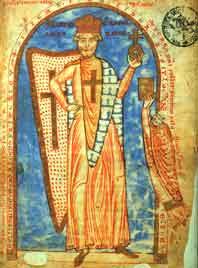
Emperor Frederick Barbarossa
The orb topped with a cross in his hand symbolizes the world (spherical) ruled by the cross.
 Of all the erroneous ideas in modern popular history, perhaps none annoys me more than the notion that mediaeval man thought that the world was flat. This persistent falsehood is almost always perpetuated in one of two ways: in reference to Christopher Columbus’ voyage to the New World or to the ignorance of the ‘Dark Ages’, particularly in allusion to mediaeval Christians. New York Times columnist Thomas Friedman writes that “Columbus reported to his king and queen that the world was round, and he went down in history as the man who first made this discovery”. I hope Pythagoras and Aristotle weren’t reading MSNBC’s website that day. And then there is poor Eratosthenes. He knew that the sun was directly overhead at noon on the summer solstice at Syene, in Egypt. Assuming that the sun was so far away that its rays could be considered to be parallel, he used geometry and trigonometry to calculate the circumference of the earth based on a stick placed in the ground at Alexandria in c. 240 BC. He was within 2% and 20% of the actual measurement. Although a few isolated pagan philosophers and early Christians still doubted the round earth theory, the evidence points to the predominate belief in Western Civilization in a round earth since Classical Greece. It’s hard to argue with Bede, Thomas Aquinas, and Dante on the mediaeval weltanschauung. The myth may make the Columbus story more exciting – the adventurer and explorer convinces the crown that he can do the impossible, despite fears that he would sail off the end of the earth – but does it really make sense? This would be like the United States and Russia competing to go to a Moon that most people didn’t believe existed. Would NASA really have gotten the funding?
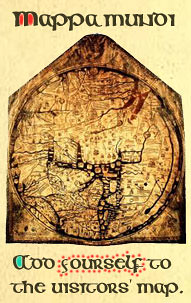
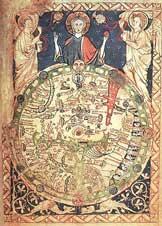
A mediaeval world map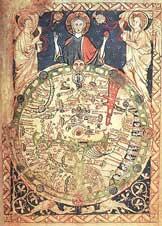 So when was this falsehood born? Jeffrey Burton Russell at UCSB has tracked the invention to two individuals in 1830s France: the French anti-religious scholar Antoine-Jean Letronne and the American writer Washington Irving. My guess would be on the Frenchie, as he studied both geography and patristics, promoting the medieval flat earth view in On the Cosmographical Ideas of the Church Fathers. Depicting the mediaeval view as such would well fit his secular polemic. Irving popularized the idea that Columbus faced a hostile crowd of inquisitors and sinister theologians who ridiculed his plans to reach the east by sailing westward. Columbus was opposed not by silly, superstitious clerics who thought the world flat, but by wise men who knew the earth was rather larger than he estimated it to be. That he stumbled upon a unknown continent and did not perish crossing both the Atlantic and the Pacific is pure Serendipity. The distortion probably survived in the case of Columbus because it made the story so much better to tell to schoolchildren. In a way, we rather like the idea of falling off the end of the earth. On a hike following High School, my friend Alex and I concluded that the world was none other than a giant pyramid standing on its tip and rotating like a top. Not that we believed this, mind you, but it does offer a more entertaining cosmology than a bunch of spheres. (The solar system is rather like a slow game of billiards…perhaps the Creator is off playing hungry hippos in another section of the universe?) There is, however, another reason the myth survives. It was a useful attack on religious faith in the conflict between science and religion (when are we going to get an exit strategy on that war?), particularly in the debate over Darwinism. It became the standard attack by proponents of ‘science’ on proponents of ‘religion’: ‘these are the same ignorant fools who thought that the earth was flat’. Of course the ultimate irony of such attacks is that they display the ignorance of the attacker, not of the intended victim. And so should they. As Edward Grant observed, “If revolutionary rational thoughts were expressed in the Age of Reason, they were only made possible because of the long medieval tradition that established the use of reason as one of the most important of human activities”. I suppose the only solution is a more well-rounded history education. Labels: 2005, History
But I didn't mean to vote for the Viscount Buchanan!

The electoral map of 1708 as seen on the Haggis News Channel.
I met up with the nearly Dr. Campbell today at the national archives in Edinburgh. He is working on an article on the election of the Scottish peers in 1708, following the Union of Scotland and England in 1707. It is a spin off from another article nearly ready for publication on the Earl of Breadalbine. We spent the day looking over a few of records of the election, the only three that he has found in existence. Turns out that no one has looked at them in a very long time. We compared two of the documents, identifying several discrepancies. The documents appear contemporary, which means that they are about seventy years older than the US. The discrepancies of course gave way to election 2000 humour. I reckon they had a map of Scotland with red and blue Tory and Whig lordships. Perhaps given the discrepancies, the Tories should have demanded a recount, appealing to Queen Anne. They could then spend the next four years whining about Whig illegitimacy which, given the Glorious Revolution of twenty years earlier and the rightful Stewart heirs threatening to return from the continent, may not have won them any favour at court (as the Rev. Jackson discovered when his illegitimate child was discovered).
Labels: 2005, History, Politics
|